Palmchat: the national bird of the Dominican Republic
Cigua Palmera
Dulus dominicus · palmchat · ave nacional
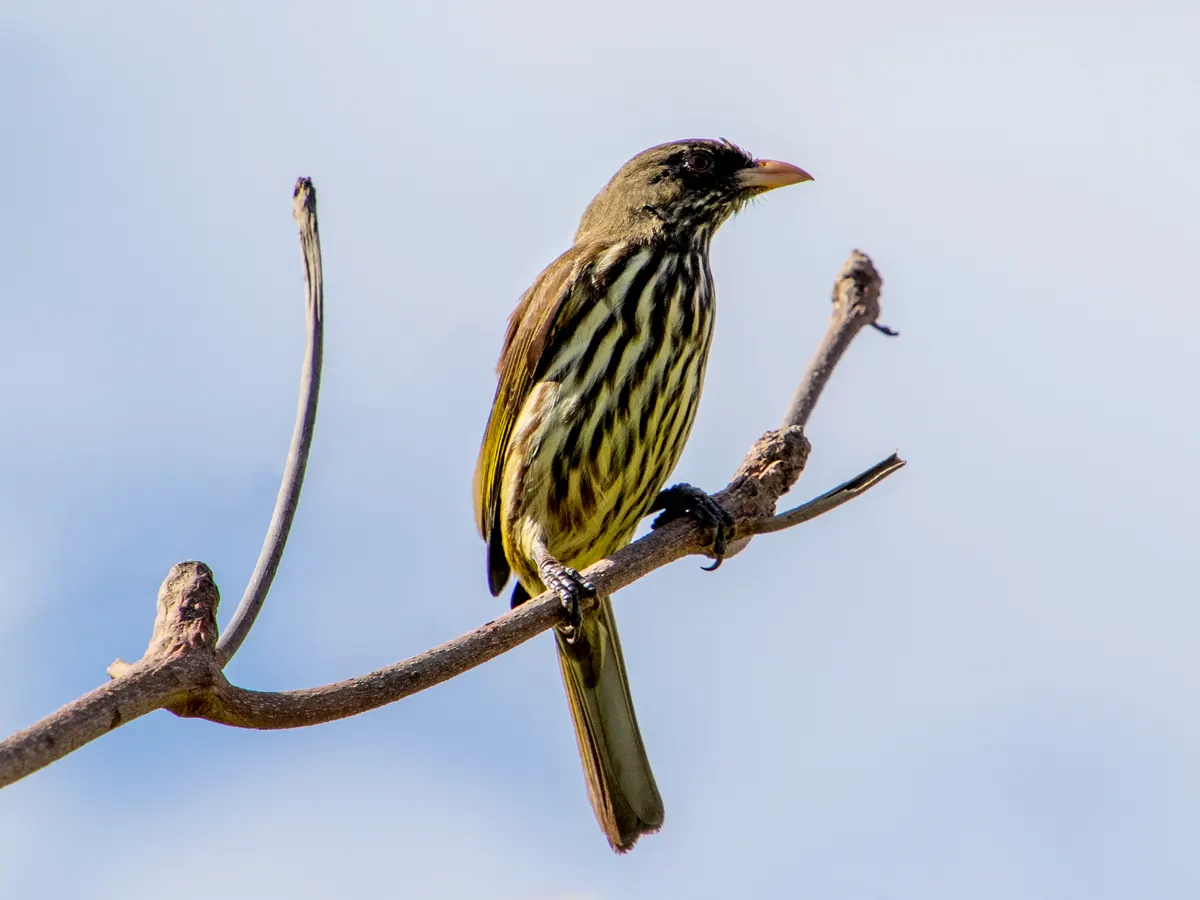
Definition
The palmchat (Dulus dominicus), called cigua palmera in Spanish, is the Dominican national bird and a songbird endemic to Hispaniola and nearby islands.
Explanation
It is the sole species in the family Dulidae. Its olive-brown upperparts, pale streaked underparts and sturdy bill help distinguish it. Palmchats live socially and call frequently, making their presence noticeable even when foliage hides them.
Cultural Context
As a national symbol it connects Hispaniola's biodiversity with Dominican identity. The species also occurs in Haiti, so its natural range crosses political boundaries.
Communal nests
Palmchats build large stick structures containing separate chambers and entrances. Pairs can occupy individual chambers. Palms are characteristic nesting sites, although they are not the only possible sites. A communal nest does not mean every pair shares the same cavity.
Food and habitat
The birds feed mainly on fruit and also consume flowers. They occur in wooded open landscapes, gardens and forest edges. Fruit-eating birds can contribute to seed dispersal and vegetation regeneration.
Watching responsibly
Look for large stick nests in urban parks and rural landscapes, and listen for calls from a distance. Avoid climbing nest trees, handling branches or playing recorded calls to attract birds. Binoculars help reveal their markings without disturbing them.
Frequently asked questions
Is the palmchat a pigeon?
No. It belongs to its own songbird family, Dulidae.
Does it live only in the Dominican Republic?
No; it also occurs in Haiti and on nearby islands.
Why are several birds at one nest?
They build communal structures with individual chambers.
Related terms
Bandera nacional
The Dominican national flag consists of four blue and red quarters divided by a white cross, with the national coat of arms at the center of the official state version.
FoodCacao dominicano
Dominican cacao is the fruit and seed of Theobroma cacao grown in the Dominican Republic, an important agricultural crop and chocolate ingredient.
CultureFlor de Bayahíbe
The Bayahíbe rose (Leuenbergeria quisqueyana) is an endemic Dominican cactus designated the national flower by Law 146-11 in 2011.
CultureFlamboyán
The flamboyán (Delonix regia), or royal poinciana, is an ornamental tree native to Madagascar, known for its spreading crown and red-orange flowers.