Flamboyán: the flame tree in the Dominican Republic
Flamboyán
flamboyant · Delonix regia · royal poinciana
Definition
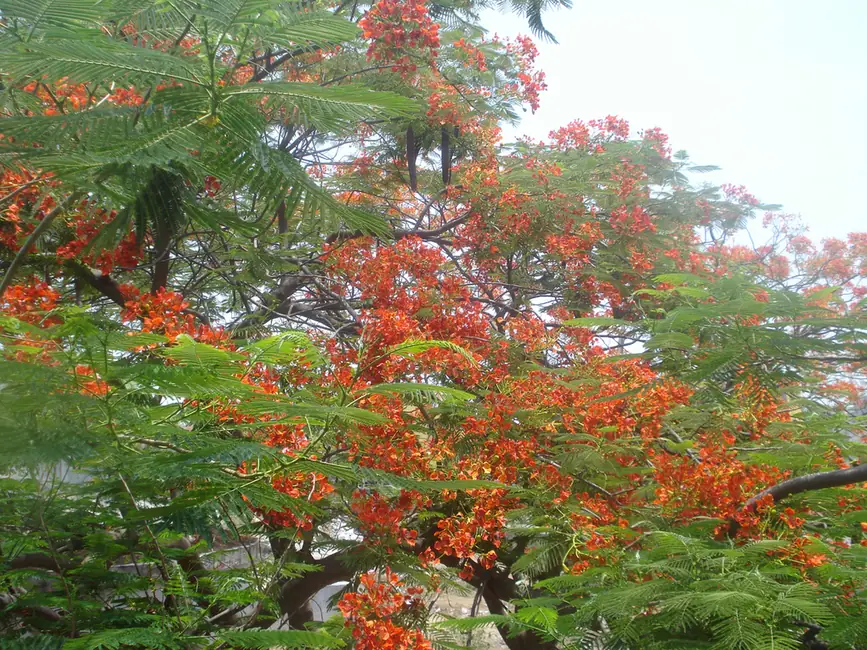
The flamboyán (Delonix regia), or royal poinciana, is an ornamental tree native to Madagascar, known for its spreading crown and red-orange flowers.
Explanation
It belongs to Fabaceae. Its leaves divide into numerous small leaflets, and its fruit is an elongated pod that hardens as it matures. The broad crown offers shade. Flowering depends on local conditions and season.
Cultural Context
Introduced into many tropical regions, it is grown in Dominican parks, gardens and urban spaces. Its familiar presence does not mean that it is native to Hispaniola.
Flowers and leaves
Large, bright flowers cluster near branch tips. The compound leaves resemble fine green feathers. In dry conditions the tree may lose some of its foliage, so its appearance changes throughout the year.
Origin and distribution
The species comes from Madagascar and is widely cultivated outside its native range. Distinguish native vegetation from introduced ornamentals. A tree familiar in everyday landscapes is not necessarily endemic.
Shade and urban space
The spreading crown offers shade, but mature trees need room for branches and roots. Planting near pavement or buildings requires appropriate planning. Fallen flowers and pods are part of the tree's natural cycle.
National symbols
Flamboyán is not the Dominican national tree, which is mahogany. Nor is it the Bayahíbe rose, a cactus. These plants may all have visual or cultural importance without sharing the same origin or botanical family.
Frequently asked questions
Is it native to the Dominican Republic?
No, it originated in Madagascar.
Is it the national tree?
No, that is mahogany.
What color are the flowers?
Usually red or orange-red.
Related terms
Flor de Bayahíbe
The Bayahíbe rose (Leuenbergeria quisqueyana) is an endemic Dominican cactus designated the national flower by Law 146-11 in 2011.
CultureCigua Palmera
The palmchat (Dulus dominicus), called cigua palmera in Spanish, is the Dominican national bird and a songbird endemic to Hispaniola and nearby islands.
CultureEl Cibao
El Cibao is a broad region of northern Dominican Republic, known for its agricultural valley, cities and cultural traditions.