Dominican Dembow: Rhythm, History and Urban Culture
Dembow dominicano
/dem-BOU/
Dembow
- Original name
- Dembow dominicano
- Common short name
- Dembow
- Approximate pronunciation
- dem-BOU
- Category
- Music & Dance
- Secondary topic
- Urban Culture
- Country of development
- Dominican Republic
- Development period
- From early experiments in the 1990s to broader recognition in the 2000s and 2010s
- Important musical roots
- Jamaican Dancehall, Reggae en español, early Reggaetón and Hip-Hop
- Typical characteristics
- Fast rhythm, repetition, electronic production, short vocal phrases, Dominican slang and high energy
- Performers may be called
- Dembowseros and Dembowseras
Definition
Dominican Dembow is an urban music genre from the Dominican Republic known for its fast tempo, repetitive rhythmic patterns, energetic vocal delivery and creative use of Dominican everyday language. It developed through a transnational exchange involving Jamaican Dancehall, Reggae en español, early Reggaetón, Hip-Hop and Dominican urban music culture.
What is Dominican Dembow?
The fast urban sound of the Dominican Republic.
Dominican Dembow is a distinct style of Dominican Música Urbana. Its productions are often built on a fast, heavily syncopated and repeated rhythm, over which singers and rappers deliver short lines, choruses, exclamations and rhythmic word patterns.
The rhythm usually matters more than complex harmonies or long melodic arcs. Repetition here is not a careless flaw but a deliberate musical tool. It creates recognizability, physical energy and room for dancing, audience reactions and spontaneous variation.
The exact sound differs considerably. Dembow can be:
- •humorous
- •aggressive
- •playful
- •provocative
- •minimalist
- •melodic
- •electronic
- •strongly rap-influenced
- •arranged for large pop productions
Not every production shares the same characteristics.
The Dembow rhythm and Dominican Dembow are not the same
The word “Dembow” can refer to two related but different things.
Use “Dembow rhythm” for the general rhythmic pattern and “Dominican Dembow” for the Dominican genre wherever clarity is needed.
The Dembow rhythm
The Dembow rhythm is a syncopated rhythmic pattern with roots in Jamaican Dancehall. It became highly influential in Reggae en español, Puerto Rican underground music, Reggaetón and other forms of Latin urban music.
- •The name is often linked to the Jamaican song “Dem Bow” by Shabba Ranks, released in 1990.
- •The rhythmic history is broader than one song.
- •Jamaican producers and Dancehall culture are central to its development.
- •The original song and its lyrics are not the same as the later Dominican genre.
- •Using a Dembow-derived rhythm does not automatically make a song Dominican Dembow.
Dominican Dembow as a genre
Dominican Dembow is the Dominican genre that developed by accelerating, restructuring and locally reinterpreting these transnational rhythms.
- •faster rhythmic movement
- •Dominican vocal delivery
- •neighborhood language
- •local humor
- •distinctive production techniques
- •short, memorable hooks
- •Dominican dance and party culture
- •influences from Rap, Hip-Hop and other Caribbean genres
Where does the name Dembow come from?
The name is commonly connected with Shabba Ranks' 1990 Dancehall recording “Dem Bow”. The underlying rhythmic history, however, developed through Jamaican sound-system and Dancehall culture and was later adapted in different countries.
The musical route runs through Jamaica, Panama, New York, Puerto Rico and the Dominican Republic. This is not a simple linear transfer in which one country merely copied another. The history of Dembow is a history of Afro-Caribbean migration, technical innovation and musical reinterpretation.
The original recording contained views that should not be treated as representative of the later Dominican genre.
The Jamaican roots
Jamaican Dancehall is a central foundation of the rhythmic line that later led to Dembow.
- •riddim-based production
- •sound systems
- •DJs and deejays
- •electronic drum machines
- •repeated instrumental tracks
- •different vocal performances over the same or related riddims
- •Afro-Caribbean rhythmic traditions
Individual producers such as Steely & Clevie should only be named when their role and the relevant riddim history are supported by reliable musicological sources. No single producer legally or culturally owns every later use of a related rhythm.
From Panama and Puerto Rico to the Dominican scene
Panamanian musicians performed Spanish-language versions and adaptations of Jamaican Reggae and Dancehall. Puerto Rican DJs, rappers and producers then developed an underground culture that combined Jamaican-derived rhythms with Hip-Hop, Spanish-language rap, mixtape culture and electronic production.
- •Jamaican-derived rhythms
- •Hip-Hop
- •Spanish-language rap
- •mixtape culture
- •electronic production
Recordings such as DJ Playero's mixtapes and Puerto Rican mixtape culture also circulated in the Dominican Republic and influenced local DJs and performers. Dominican Dembow, however, is not culturally identical to Panamanian Reggae en español or Puerto Rican Reggaetón.
The early years of Dominican Dembow
Local experiments began in the 1990s. DJ Boyo, also written as DJ Bollo in some sources, is frequently cited as an early pioneer connected with Guachupita in Santo Domingo. “Mujeres Andadoras” is often described as an early Dominican Dembow recording; some sources date it to 1994, but accounts of the very first recording may vary. DJ Boyo should be presented as an important pioneer rather than the unquestioned sole inventor.
- •neighborhood DJs
- •improvised studios
- •local parties
- •mixtapes
- •borrowed and adapted riddims
- •informal distribution
- •urban youth networks
The entire genre was not created in a single recording session.
Guachupita and the neighborhoods of Santo Domingo
Neighborhoods such as Guachupita played an important role without being reducible to poverty or crime. They offered access to local parties and sound systems, space for youth creativity and small recording environments, and networks for performance and distribution. You can learn more about urban culture in Santo Domingo to understand the context of the capital.
- •access to local parties and sound systems
- •youth creativity
- •small recording environments
- •neighborhood performance networks
- •local language and humor
- •limited access to established media and record companies
Dembow did not develop only in Guachupita. Different neighborhoods and later other Dominican cities contributed to the genre.
“Ando Loco” and the spread in the 2000s
The 2006 track “Ando Loco” by Los Ando Locos is frequently cited as a major milestone.
- •its role in giving the genre broader neighborhood recognition
- •the use of a direct and memorable Dembow rhythm
- •circulation outside traditional radio and television
- •distribution through copied files, CDs, USB devices and the internet
- •influence on later performers
Successful Dembow existed before this recording. It is not the uncontested first Dembow hit.
“Pepe” and the nationwide breakthrough
“Pepe” by Doble T y El Crok became an important national and international breakthrough around 2009.
- •reaching audiences beyond the original underground scene
- •helping establish Dembow as a nationally recognizable genre
- •demonstrating the commercial potential of a highly repetitive hook
- •drawing greater attention from media and the music industry
A single song did not create the genre's popularity.
What does Dominican Dembow sound like?
Dominican Dembow is usually noticeably faster than commercial Reggaetón, but tempo and production vary by artist, era and style.
- •fast, syncopated percussion loop
- •strong kick and snare accents
- •repeated rhythmic cells
- •electronic bass
- •short samples
- •sparse harmonic accompaniment
- •vocal chants
- •call-and-response
- •ad-libs
- •rapid rhythmic delivery
- •sudden breaks
- •repeated hooks
- •sound effects
- •producer tags
The genre often prioritizes rhythmic impact, vocal personality, memorability, physical movement and collective response. Not all songs use the same beat.
Why is repetition so important?
Repetition can make the rhythm instantly recognizable, support dancing, invite audiences to join in, turn a phrase into a collective chant, emphasize a joke or expression, create tension and release, and make short songs memorable. It works especially well in clubs and social-media clips.
- •make the rhythm instantly recognizable
- •support dancing
- •invite audiences to join in
- •turn a phrase into a collective chant
- •emphasize a joke or expression
- •create tension and release
- •make short songs memorable
- •work in clubs and social-media clips
Critics sometimes see excessive repetition as artistically limiting. Repetition, however, is a deliberate musical technique and not automatically poor songwriting.
Voice, flow and delivery
Dembow performers may use rapid-fire delivery, shouted phrases, melodic fragments, spoken rhythms, changes in vocal pitch, exaggerated pronunciation, vocal effects, humor, improvised-sounding ad-libs and call-and-response. The voice often functions as an additional rhythmic instrument.
- •rapid-fire delivery
- •shouted phrases
- •melodic fragments
- •spoken rhythms
- •changes in pitch
- •exaggerated pronunciation
- •vocal effects
- •humor
- •improvised-sounding ad-libs
- •call-and-response
Clear standard pronunciation is not required. Dominican accents and local speech patterns are a central part of the genre's identity.
Language and Dominican slang
Dembow frequently uses Dominican slang, neighborhood expressions, shortened words, inventive phrases, double meanings, humorous exaggeration, newly created terms and references to fashion, status, relationships and local life. Some words become popular nationally through songs and social media. Lyrics can therefore serve as entertainment, documentation of changing language, identity markers, sources of new expressions and links between neighborhoods and the diaspora. Explore Dominican slang terms such as Klk or Vaina.
- •Dominican slang
- •neighborhood expressions
- •shortened words
- •inventive phrases
- •double meanings
- •humorous exaggeration
- •newly created terms
- •references to fashion, status, relationships and local life
Not every lyric is a reliable dictionary definition.
What are Dembow songs about?
Themes vary widely.
- •parties
- •dancing
- •attraction
- •relationships
- •sexuality
- •fashion
- •money
- •cars
- •status
- •rivalry
- •humor
- •neighborhood life
- •personal success
- •social frustration
- •internet trends
- •everyday observations
- •migration
- •police and authority
- •gender roles
Not every song is explicit. Not every song glorifies wealth or violence. Some tracks rely mainly on humor or dance instructions, some address social realities, and others are created primarily for entertainment. Lyrics should not be treated as uniformly autobiographical.
Dembow and dance
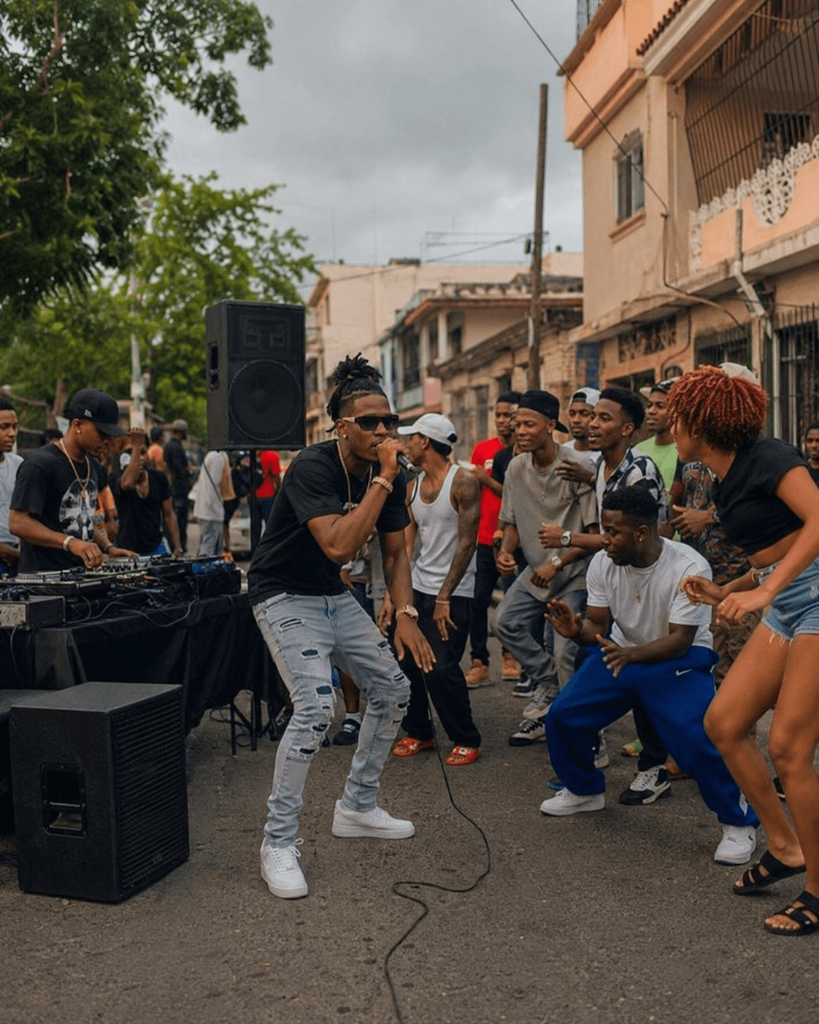
Dominican Dembow is closely connected with physical movement and social dancing.
- •parties
- •clubs
- •neighborhood gatherings
- •concerts
- •dance challenges
- •social-media videos
- •vehicles and mobile sound systems
- •informal celebrations
Dancing may be individual, in pairs, in groups, improvised, trend- or challenge-based, and focused on footwork, hips, shoulders or whole-body movement. There is no official Dembow choreography, and not every form of Dembow dancing is sexual. Dance styles change quickly and differ between communities and generations.
What does “Teteo” mean?
“Teteo” is commonly used in Dominican urban culture for a lively party or gathering, particularly one involving urban music, dancing and social activity. Not every Dembow event is called a teteo. The term can carry different associations depending on context and can refer to both organized events and informal gatherings.
A dedicated Teteo entry in the dictionary is planned; once published, it will be linked here.
Dembow and Reggaetón compared
Dominican Dembow
- •developed as a distinct genre in the Dominican Republic
- •often faster
- •frequently more rhythmically repetitive
- •often uses sparse or highly percussive production
- •strongly connected with Dominican slang and vocal delivery
- •short hooks and collective chants are common
- •neighborhood and internet-based circulation played an important role
Reggaetón
- •developed through Panamanian, Puerto Rican, New York and wider Caribbean exchanges
- •commonly uses a related Dembow-derived rhythm
- •often has a slower or mid-tempo feel
- •frequently uses more melodic and pop-oriented song structures
- •has a larger established international commercial industry
- •includes many regional and stylistic variations
The genres overlap; artists move between both, and one song may combine characteristics of both. “Reggaetón” should not be used as an automatic label for all Spanish-language urban music.
Dembow, Dominican Rap and Latin Trap
Dominican Rap
- •stronger emphasis on extended verses and lyrical technique
- •wider range of Hip-Hop beats
- •often prioritizes storytelling, freestyle or social commentary
Latin Trap
- •often slower, darker or more spacious production
- •melodic rap and heavy bass
- •different rhythmic foundation from classic Dominican Dembow
Dominican Dembow
- •particularly strong emphasis on fast rhythmic repetition
- •closely connected with dancing
- •often uses shorter phrases and hooks
Dominican artists frequently combine these styles. Not every performer fits into only one category.
From mixtapes and USB sticks to YouTube and social media
Early and developing scenes relied on local DJs, parties, copied CDs, mixtapes, shared MP3 files, USB devices, mobile phones and informal street distribution. Later platforms included YouTube, streaming services, social networks, short-form video platforms and messaging apps.
- •local DJs
- •parties
- •copied CDs
- •mixtapes
- •shared MP3 files
- •USB devices
- •mobile phones
- •informal street distribution
- •YouTube
- •streaming services
- •social networks
- •short-form video platforms
- •messaging apps
Digital circulation allowed artists to reach audiences without immediate support from major record labels, traditional television, national radio or elite cultural institutions. No single platform alone made the genre successful.
Social exclusion and recognition
Dembow was historically rejected by parts of traditional media, established Hip-Hop communities, middle- and upper-class audiences, cultural institutions and the formal music industry.
- •repetitive production
- •explicit language
- •sexual content
- •limited musical complexity
- •perceived association with marginalized neighborhoods
Some criticism reflected genuine debates about artistic and social responsibility. Other criticism was influenced by class prejudice, racism and colorism, discrimination against poor urban communities, generational conflict and discomfort with new forms of youth language and sexuality. Not every criticism is prejudice, and discriminatory stereotypes are not objective truth.
Debates about gender, sexuality and violence
Some songs and videos have been criticized for misogynistic language, objectification, homophobia, glorification of violence and aggressive ideas of masculinity. At the same time, artists have used Dembow to express female sexual agency, personal independence, humor, social critique, nontraditional identities and resistance to respectability politics.
- •misogynistic language
- •objectification
- •homophobia
- •glorification of violence
- •aggressive ideas of masculinity
The genre contains multiple and sometimes contradictory perspectives. A single artist or controversial song is not representative of the entire genre. Explicit lyrics are not reproduced here unnecessarily.
Women in Dominican Dembow
The genre has historically been strongly male-dominated, but female performers have gained greater visibility. Artists such as Tokischa, La Perversa, Yailin La Más Viral, Gailen La Moyeta and, in the wider urban scene, Melymel represent different musical styles and perspectives and do not perform only Dembow.
- •access to the industry
- •double standards
- •sexual expression
- •online visibility
- •artistic independence
- •collaboration and competition
Female performers should not be reduced to appearance or controversy.
Important artists and phases of development
This overview is not definitive. Date of last artist-section review: July 28, 2026.
Early pioneers and trailblazers
Frequently named early figures and groups include DJ Boyo, Los Ando Locos, Doble T y El Crok, Pablo Piddy, Black Point and Secreto El Famoso Biberón. The specific contribution of each person should be verified before publication.
Commercial and international expansion
Artists associated with the expansion include El Alfa, Chimbala, El Mayor Clásico, Bulin 47, Kiko El Crazy, Rochy RD, Musicólogo and Lírico en la Casa.
New voices and international attention
Newer voices include Tokischa, La Perversa, Yailin La Más Viral, as well as emerging women and independent performers, and producers and DJs shaping current variations.
El Alfa and international spread
El Alfa has played an important role in bringing Dominican Dembow to wider international audiences through collaborations, international tours, streaming, music videos and connections with Reggaetón, Hip-Hop and Latin Pop artists.
- •collaborations
- •international tours
- •streaming
- •music videos
- •connections with Reggaetón, Hip-Hop and Latin Pop
He did not invent the genre. The scene existed before his commercial breakthrough, and many other artists, DJs and producers contributed to its development. His international success represents one important phase.
Chimbala, Tokischa and other international connections
Chimbala is associated with a dance-oriented and widely accessible form of Dominican Dembow. Tokischa has attracted international attention through provocative artistic expression and collaborations across Dembow, Rap, Reggaetón and other genres. Other performers have expanded the genre through Latin Pop collaborations, electronic fusions, international festivals, diaspora audiences and digital platforms.
Neither Chimbala nor Tokischa should be reduced to a single song or controversy.
Dembow in the Dominican diaspora
Dominican communities in New York, other parts of the United States, Spain, Puerto Rico, Italy and other diaspora locations contribute to the genre.
- •DJs
- •clubs
- •concerts
- •online promotion
- •collaborations
- •language exchange
- •fashion and dance trends
- •connections between Dominican and international urban music
Dembow does not exist only within the Dominican Republic.
New hybrid forms
Dembow continues to evolve through combinations with Trap, Drill, Reggaetón, Dancehall, Brazilian Funk, electronic music, House, Bachata, Merengue, Afrobeat- or Afrobeats-influenced production and Pop.
- •Trap
- •Drill
- •Reggaetón
- •Dancehall
- •Brazilian Funk
- •electronic music
- •House
- •Bachata
- •Merengue
- •Afrobeat-/Afrobeats-influenced production
- •Pop
Named hybrid genres such as “Trapbow” or “Demvogue” should only be mentioned when documented and contextually relevant. Short-lived marketing labels are not universally recognized genres.
Cultural significance
Dominican Dembow is one of the most formative urban expressions of the Dominican Republic today. The genre connects music, language, dance, fashion, humor and digital culture. Especially for many people from urban and socially disadvantaged neighborhoods, it has offered and still offers a way to make their own experiences, terms and aesthetic visions publicly visible.
Its cultural significance, however, lies not only in its connection to youth. Dembow is now heard, produced, discussed and developed internationally by several generations. At the same time, the genre remains the subject of social debates about art, class, language, gender, morality and cultural recognition.
Dembow is not the only voice of Dominican youth and does not represent every Dominican community.
Examples
«El dembow dominicano se baila en muchas fiestas y teteos.»
Dominican Dembow is danced at many parties and teteos.
The sentence describes the genre's strong connection with dance and urban celebration culture. It does not mean that Dembow is played at every Dominican event.
«Ese artista mezcla dembow con trap y música electrónica.»
That artist combines Dembow with Trap and electronic music.
Here “dembow” can refer to the rhythm rather than necessarily to the complete genre.
«La canción tiene un dembow rápido y un coro muy repetitivo.»
The song has a fast Dembow rhythm and a highly repetitive chorus.
Here too “dembow” can denote the rhythm.
«Muchas palabras del barrio se hicieron populares a través del dembow.»
Many neighborhood expressions became popular through Dembow.
Dembow acts as a vehicle for urban language.
Frequently asked questions
What is Dominican Dembow?
Dominican Dembow is a fast, rhythm-centered urban music genre developed in the Dominican Republic.
Where does Dembow come from?
The word connects a Jamaican-derived rhythm with a distinct Dominican genre. The history runs through Jamaica, Panama, Puerto Rico, New York and the Dominican Republic.
Is Dembow the same as Reggaetón?
No. They share rhythmic roots but differ in tempo, production, vocal style and cultural development.
Why is the genre called Dembow?
The name is historically linked to the Dancehall recording “Dem Bow” and the wider rhythmic lineage that grew from it.
Who invented Dominican Dembow?
No single person invented the genre. DJ Boyo is often cited as an important early pioneer, but many DJs, producers and performers contributed over decades.
When did Dominican Dembow emerge?
Early experiments are documented in the 1990s, while broader national recognition developed during the 2000s and 2010s.
Which songs were important for its development?
Frequently cited milestones are “Mujeres Andadoras”, “Ando Loco” and “Pepe”, though this is not a complete list.
Why is Dembow often so fast?
Dominican producers accelerated and restructured the rhythm to create a more intense, dance-focused sound.
Why do many Dembow lyrics repeat so much?
Repetition creates rhythmic impact, makes phrases memorable and invites audiences to participate.
Are all Dembow lyrics explicit?
No. Some are explicit, while others focus on humor, dancing, relationships, status, everyday life or social themes.
What is a Dembowsero?
“Dembowsero” or “Dembowsera” refers to a performer associated with Dembow.
What is the difference between Dembow and the Dembow rhythm?
The rhythm appears in many genres, while Dominican Dembow is a specific Dominican genre and cultural scene.
Is Dembow popular only with young people?
No. It has a particularly strong relationship with youth culture, but its audience now spans different generations and countries.
Related terms
Mambo de calle
Mambo de calle, also known as merengue urbano or merengue de calle, is a modern, urban take on merengue that blends traditional Dominican rhythms with electronic influences and street music culture.
MusicBachata
Bachata is a music genre and social dance from the Dominican Republic. Its characteristic sound is primarily defined by guitars, bass, Bongó, and Güira. The lyrics frequently deal with love, longing, heartbreak, passion, and everyday life experiences. After long being socially marginalized, it evolved into an internationally recognized symbol of Dominican culture.
MusicMerengue
Merengue is one of the most important musical genres and dances of the Dominican Republic, and a central part of Dominican national identity.
Everyday LifeColmado
A Colmado is a small Dominican neighborhood store selling groceries, drinks, household products and other everyday essentials. Depending on the business and neighborhood, it may also offer local delivery, informal credit or a place where neighbors briefly meet and talk.
LanguageKlk
Abbreviation of 'qué lo qué', a casual Dominican way of saying 'what's up?' or 'how's it going?'.
LanguageVaina
A catch-all word used to refer to almost any thing, situation, or object.